
Aaron Charlton · November 25, 2024
Why Most Corporate Blog Posts Are Useless
Why business blogs struggle to earn attention, and how topic selection, internal links, and audience focus can help.

As a business owner or manager, you likely hear it all the time: “You need a blog,” or “Consistent blogging helps you rank higher on Google.” Yet, for many businesses, blogging ends up being mostly a waste of time. Why is that? If you feel like your blog isn’t doing anything for your business, keep reading—I’ll go into the key reasons your posts aren’t working and give you some simple fixes.
1. Burned Over Topic

A “burned over topic” refers to a subject that has been overly discussed or analyzed to the point where there’s little new insight or value left. It originates from the Burned-Over District in 19th-century New York, an area heavily targeted by religious revivals. In modern usage, it describes topics that feel exhausted or repetitive, like overdone debates on “work-from-home” policies.
Think about this: Why would Google even index your blog post if it already has 5 million web pages from higher authority websites on the same exact topic? It doesn’t need exactly the same thing from a low-authority website. Google’s memory storage resources are finite. But even if it does index your page, how will you climb the rankings and get past hundreds (or thousands) of higher authority websites?
The solution is that you want to go after keywords that are less competitive in your blogging efforts–especially early on while you work on building authority. Don’t swing for the fences! Just try a few bunts at first.
Measuring the competition
It’s actually quite possible to see what your competition is for a given set of keywords using Google’s own tools:
- Go to Google Advanced Search
- In the “all these words” box, put your main keywords. For example, “CPAP alternatives.”
- In the “terms appearing” box, select “in the title of the page.”
- Hit the “Advanced Search” button.
- On the search results page
- Click the “Tools” link in the horizontal nav at the top of the search results.
- On the far right, you’re going to see the number of results–that’s your competition.
- Now look to see what sites are ranking high. If they’re all academic and government sites, you may have a tough job outranking any of them
If you go after less competitive keywords, you will get more content to rank faster, which creates a snowball effect where more and more of your content ranks. Having built some initial authority in this way, you can then start to go after increasingly more competitive keywords.
2. Improper Internal Linking Structure
Too often, corporate blog posts link only to external resources such as government websites and other, more authoritative web properties. Why is this a problem? Well, if you don’t link to your own stuff, you give Google the impression it’s not important. What’s worse, Google may not even find your content if you don’t link to it. This is because Google crawls your website by bouncing from link to link. When many pages link to one page on your site, that signals to Google that the page with all the links to it is very important. When zero pages link to a given page, Google’s bots never click through to it, and even if Google does happen to find the page another way, it assumes that the page is of little importance since it’s not linked. Pages without links rarely make it into Google’s index.
Think of link structures as Christmas lights

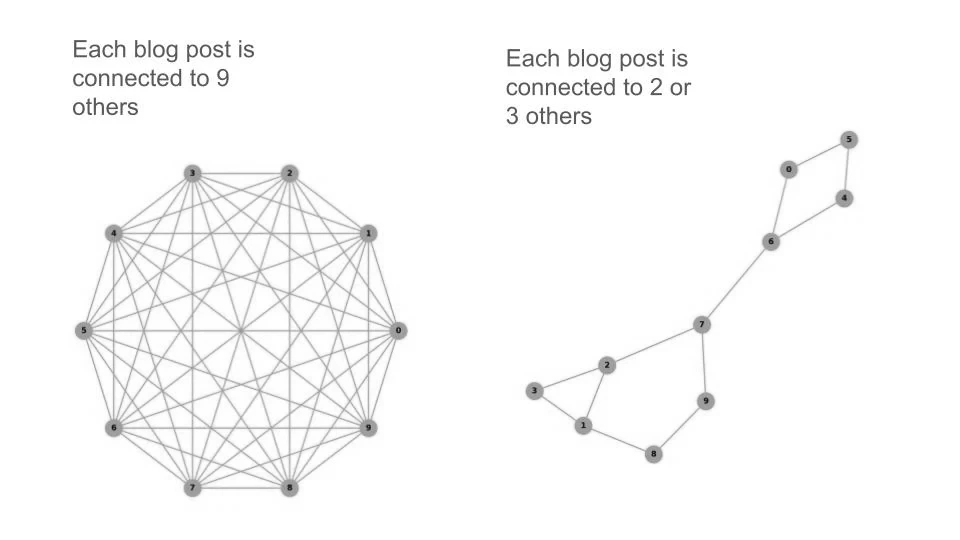
If you’ve ever hung Christmas lights, you know that many are designed so that if a single light bulb burns out, everything after it becomes dead as well. This can be a real pain to troubleshoot. When you have more connections, you have more redundancy and one light going out is not a problem because the others stay lit. This is true of many, higher-end, light strands. Similarly, on your website, when there’s only one connection between pages, Google may not see that link or may think having only one link indicates you put little importance on the linked page. That can mean Google ignores pages on your site because links to them weren’t found.
Consider the diagram below. On the left, a broken link will do very little to diminish the importance of any of the 10 nodes because they are connected to 8 others. On the right, however, a break between the two clusters of nodes could make it so that Google doesn’t even become aware of one of the clusters. And by break, I mean that Google either doesn’t see the connection or discounts it. But if the link were broken through some technical problem, that would obviously make the problem even worse.
Below is a typical blog structure where all the top level pages (home, services, contact, about, etc.) link to page 1 of the blog archives. Page 1 links to page 2. Page 2 links to page 3. Etc. But in this case, Google doesn’t click through to page 5, ignoring all later pages. And if your blog posts aren’t linked from elsewhere, they’re dead in the water.
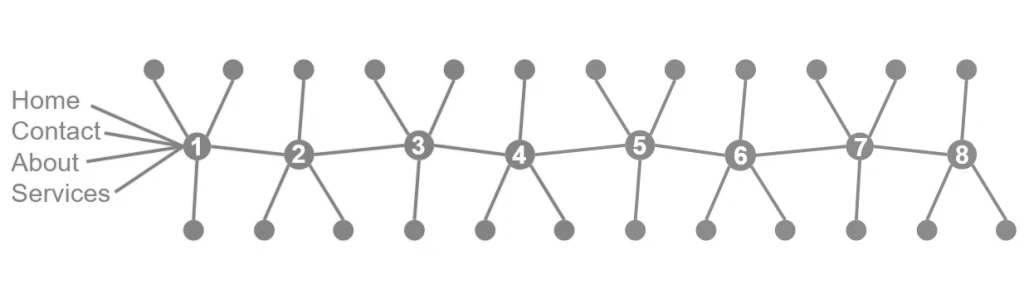
One of the big problems with counting on blog archive pages is that blog archive pages, including category and tag pages, offer little value to Google because they only include content that is redundant. For example, page 1 in this case, includes 3 blog posts. Google wants to index the blog posts but not the page that has 3 blog posts on one page. That page adds nothing. This means you can’t count on the archives pages at all for indexing, making it more important to interlink blog posts within the content itself.
In fact, I believe it is (or was) a default in Yoast SEO tool for WordPress, which nearly everyone uses, to ask Google not to index blog archive pages explicitly. So now you’re counting on a bunch of pages to connect your site together, which you have asked Google to ignore. See how that’s a problem?
3. Target Sales Page Not Linked To (Or Non-Existent)
This ties into internal linking but is crucial enough to highlight separately. A blog post’s main purpose in a proper strategy is to drive traffic and “Link Juice” to a target sales page. For example, a target page like “Teeth Whitening in Mesa, AZ” benefits from blog posts like “Comparing Teeth Whitening Treatments” linking back to it.
Visitors are more likely to convert on the sales page than on the blog, and linking related posts back to the sales page signals its importance to Google, boosting its rankings. “Link Juice” refers to the SEO value a page gains from links. The more quality links a page has—both internal and external—the higher it ranks.
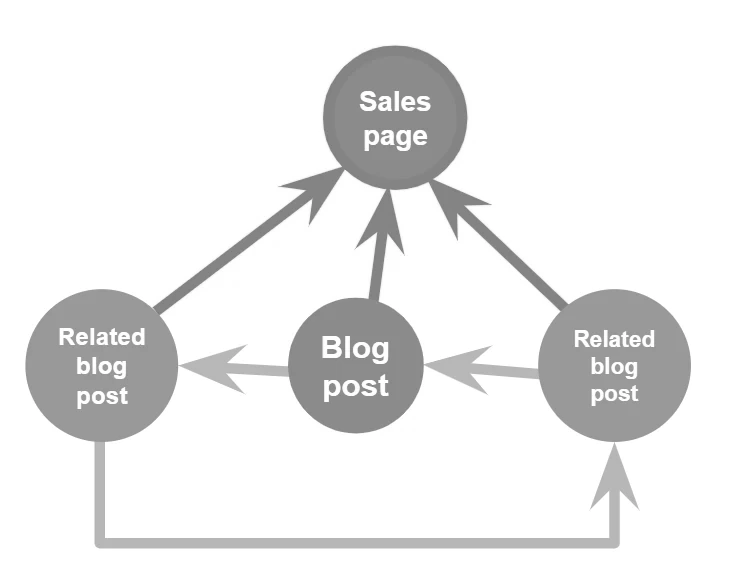
The ideal setup? Multiple blog posts linking to your sales page with every blog post linking to at least one other blog post. This maximizes Link Juice! 🧃
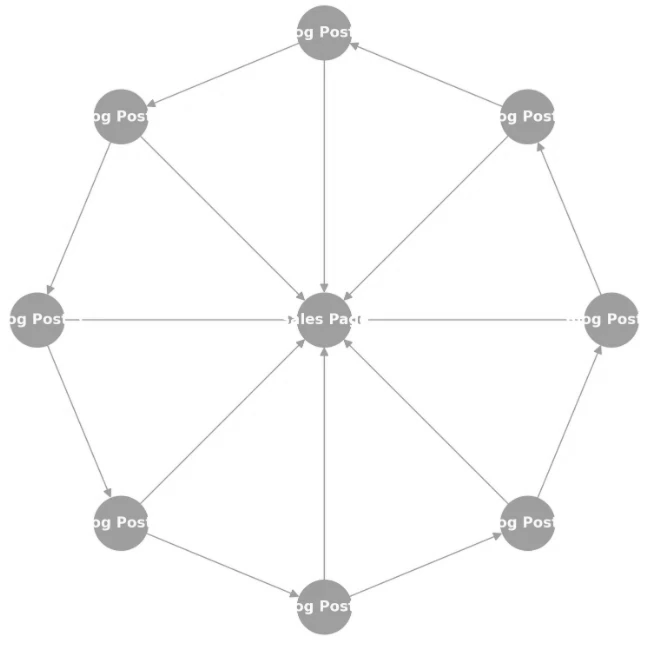
But the story doesn’t end there. You also have to optimize that target landing page, including keyword optimization, in order for it to rank. I’ll not be covering that here. The main thing to note is that blog posts are almost completely useless if they don’t drive link juice and traffic to your core target sales pages. These are usually going to be service pages and product pages.
4. Things That Go Without Saying
There are some things that are obvious but in a world where you have to tell people not to take a bath with a toaster on warning labels, I’m going to cover them lightly.
- Obscure topic. If your topic is so obscure that nobody is Googling it, that’s a problem. You can use various tools to check search volume, including free tools. You want it to sort of be obscure when you’re starting out but don’t pick something that nobody cared about ever. Hopefully, you know your audience. You can use Google Keyword Planner for this. It’s a free tool connected to the Google Ads platform.
- Bad content. If your content is mostly AI, uses AI images, is disorganized, not super informative, etc. obviously that is a problem. The content needs to be good in order to get any real benefit out of it. Many sites put out worthless content but still rank, but don’t expect that you can do the same. They often have a lot of authority or some other reason they are ranking.
- Irrelevance. Google is way less likely to care about your content if it doesn’t relate well to the rest of your site. Make sure to stay mostly on topic.
I might come back to this list and add a few others later. Just like the toaster-bath example, you never know all the ways people can screw something up.
5. No Audience

Think about who is going to be reading this stuff. Do you have a social media following? Do people want to get content from you? What kind of content you produce would people actually value? Many of the best blogging efforts are supercharged by engaged audiences who subscribe to updates, and who engage with the content on social media. If nobody cares about your content, you will be limited in how far you can get with it.
I would recommend that you start your blogging strategy by thinking deeply about the following questions:
- Who would want to read your content?
- Who do you want to read your content?
- What would these people be interested in reading?
Maybe keep an eye on what kinds of content your audience does engage with and give them more of the same? 🤔
So What Does Right Look Like Then?

Write blog posts that are related to the main topic of the website. Don’t waste your time on blog posts that are overdone already. Find unique topics that people care about. Build an audience. Find out what they care about. Make sure it’s of consistent quality. And fix your internal linking structure!
Internal linking structure
Every blog post should link to the following:
- A sales page. This means linking to a location page, service page, or product page. This link should ideally be high on the blog post. This drives link juice back to your sales page and signals to Google that the page is a really important part of your website.
- At least one related blog post. You can link to more than one blog post but the more you link to, it can diminish the link juice going to your sales page. When you link to related blog posts, it helps Google find other blog posts and signals to Google that your blog posts are important and worth indexing.
That’s it. That’s all you have to do. If you have a lot of external links, for example, links that go to other authoritative sites, you should consider pruning those back a bit. Why? Because you are actually sending your link juice out rather than using it internally. One trick you can do is to add references at the bottom of the post that link to academic articles in lieu of links.
Blogging Doesn’t Have to Be Terrible

Don’t make people read something that you don’t even want to read yourself. Maybe everyone should try writing about things they really care about in a way that speaks to them. Wouldn’t that just elevate all the world’s content? Why not start with your own? You can use AI to speed the process but don’t overuse it. Generative AI tools like Chat GPT can really water your content down. It’s good at some things but can’t make something interesting. That has to come from you. Happy blogging!
By the way, we offer search engine optimization and blogging services. Please let us know if you need help.